Act I
Air Outside the Room
Inside a motion-capture laboratory, the air stays as still as glass. Infrared cameras ring the ceiling, overhead lights never drift, and every millimeter of volume sits neatly on a grid. Inside that enclosed room, a quadrotor looks almost untroubled by gravity, snapping through corners and returning to its mark to the centimeter.
Step through the door and the world keeps none of those promises. Midday glare washes out a gate in half a second; crosswinds spill around building corners without warning; tree shadows, mist, and people walking across an open field never stay inside a preloaded map. For decades, most capable software lived safely on servers. When a paragraph of text goes wrong on a screen, a reader deletes it and tries again. When code leaves a server and takes hold of four spinning carbon blades in real air, every miscalculation carries mass and momentum.
Every time I strap a lithium pack onto a carbon frame, the same quiet question sits on the workbench. Flight as spectacle earns easy applause; flight calm and transparent enough to earn ordinary human trust under open skies asks for something deeper. From my first start line at twelve to studying physics and computer science at USC and walking younger pilots to overseas grids, nine years of my life have circled the air outside that room.
Act II
Stage Light, Rosin, and Coordinates
The first craft I learned was keeping my body still inside bright, noisy rooms.
Long before I soldered a flight controller, I grew up in Hunan spending years on runways, studio floors, and rehearsal stages. In January 2018, at twelve years old, I flew to Los Angeles for the first time for the IMTA Global Finals, competing in English alongside more than 1,700 entrants from twenty-five countries and regions and returning with nine medals, two of them gold. Stage light carries its own quiet geometry. Half a step off your mark breaks the frame; a hurried breath shows in your shoulders. Those years trained a lasting instinct: keeping my breath even inside noise, and sensing where a lens sits without turning around to look.
By then, a different set of coordinates was already taking root. At eleven, still in primary school, I flew my first DJI Phantom 3 and felt a camera, a radio link, a battery, and moving air behave as one coupled instrument. At twelve, Hunan Public Channel profiled me as the province's youngest pilot; I finished third at a municipal race in Zhuzhou and traveled to Shanghai in 2017 for my first real FPV competition.[1]
Drone racing in China had no paved lane yet. Inside Super Pulse, the crew I grew up with, everyone brought whatever skills they had. We pooled orders to cut carbon frames, clipped gates, crouched beside folding tables at the edge of the grass in curls of rosin smoke to solder snapped wires back together, and walked straight back to the start line for the next heat. Later, under the long tents of national camps and overseas races, students, engineers, factory owners, and twelve-year-old rookies worked elbow to elbow. Shaving a tenth of a second off a lap meant late nights with Betaflight contributors across time zones, wrestling through filter and PID code in broken English tangled with jargon. Half the time we misunderstood each other and laughed it off. Then we flashed the board, flew one pack, and landed. Once the quad had been through real air, everyone understood the same sentence.
In 1900 and 1901, when Wilbur and Orville Wright glided off the dunes at Kitty Hawk and found that published aerodynamic tables disagreed with the wind against their faces, they went home to their Dayton bicycle shop. Out of bicycle spokes and hacksaw blades they built delicate balances inside a six-foot wooden wind tunnel, measured more than two hundred airfoil shapes, and corrected a 140-year-old air-pressure constant from 0.005 to 0.0033.[2] Reading that piece of history always feels close to home. Real wind is more honest than any inherited table. To know how a flying machine actually behaves, you have to measure it by hand and let the outside air correct your assumptions.
In high school I stepped off the standard checklist of test drills and summer programs. Our student organization was drifting apart, so I spent a semester interviewing classmates one by one, ran a year-long live pilot in my homeroom with my teacher, and carried the results to the principal, who adopted the model across the school. Every remaining hour belonged to the flight line, hardware, and code. A teacher once told me that picking a university resembles choosing a partner: both sides have to fit, and you cannot hire a matchmaker to speak for you. After receiving a full scholarship to Rotman Commerce at the University of Toronto and an offer in Computer Science from the University of Michigan, I chose Los Angeles. Five and a half years after walking off the IMTA stage in that city, I landed there again to study Physics and Computer Science at USC.[3] Physics and code train me to trace a system down to a single noisy signal; economics and an early brush with market cycles taught me to watch the wider horizon of risk. Holding a wide horizon while refusing to gloss over a millimeter of signal belongs in the same pair of hands.
Act III
Gravity's Ledger
A racing quad empties its battery in two and a half minutes flat out. When it drops back onto the grass, the cells are hot and your palms are warm. Those 150 seconds feel like a short, intense loan, spending all stored chemical energy across a handful of corners.
At the end of 2023, while studying at USC, I came across an announcement for Fuzhou's Qiaozhihui drone competitions. I assembled a team across all five events and brought along the first public test of a high-energy-density battery system co-developed with researchers at Stanford University. The endurance event posed the mirror image of sprint racing: once a multirotor lifts off, how long can it hold its quiet bargain with gravity without touching the ground?
That December in Fuzhou, I stood at the edge of the field watching telemetry voltage tick downward alongside current draw and shifting gusts across 145 straight minutes where one slip ends the flight. In a sprint heat your eyes lock onto the next gate and your thumbs fire a dozen inputs a second. Across two and a half hours, your hands have to quiet down until patience itself becomes the control loop. We stayed airborne for 2 hours, 25 minutes, and 2 seconds to take the title.[4] Sprint and endurance look like opposite ends of the sport, yet both answer to the same quiet ledger. Gravity extends no credit: every unnecessary gram of carbon, solder, or guesswork sends its bill in the final twenty minutes. Only when everything surplus falls away does a frame begin to move on good terms with the air.
That winter led me to found Gangyi Technology in Fuzhou's High-Tech Zone, design Fujian youth competition courses weaving aerodynamics and 3D printing into racing, and fly demonstrations for students at Aofeng School.[5] Whenever a row of kids cranes its necks across a schoolyard to follow a hovering quad, I recognize the eleven-year-old holding his first radio.
Act IV
Borrowing Distance from the Inside
Across nine seasons of racing since 2017, including seven on China's national team pathway, I flew from seventh at the FAI e-Drone Racing Cup in Namwon and the DCL China Dragons roster to fifteenth overall at the 2024 World Drone Racing Championship in Hangzhou, pre-Games Team China selection for The World Games 2025 in Chengdu, and representing Hunan at the 15th National Games in Shenzhen.[6]
Yet the weekend I still replay most often happened in January 2025 at the FAI World Cup in Riyadh. Out of 135 registered entrants and 120 timed pilots worldwide, I qualified twenty-eighth with a three-lap average of 19.906 seconds per lap, nearly 4.7 seconds per lap off top qualifier Yuki Hashimoto. On raw straight-line speed, my quad belonged nowhere near the late rounds.
Straightaways belong to whoever carries the strongest thrust, yet every course hides a second arithmetic. When brute speed belongs to someone else, you borrow distance from the inside edge. Inside the goggles, the track narrows to an unseen seam beside the gate frame: swing an inch too wide and the lap bleeds away; press an inch too close and carbon shatters on contact. The discipline lies in passing an inch from shattering without yielding an inch of ground. Once elimination heats opened in Riyadh, I stripped out every hurried input. Two clean second-place runs carried me through the opening rounds. In Quarterfinal Race 27, holding the tightest inside line took me to first outright ahead of third seed Marvin Schäpper and ninth seed Dimo Shterev. In the Small Final, I crossed second behind Yuki Hashimoto to finish sixth in the world, the highest Chinese result of the week.[7]
Months later, I invited Yuki and engineer Steven onto my technical talk show LONGCHAT. Together we opened up AM32 and BLHeli_32 electronic speed controllers piece by piece: MOSFETs, dead time, PWM frequencies, video noise, and whether human thumbs can genuinely sense microsecond shifts in response.[8] Once the goggles come off and everyone sits at the same table, rivals are reading the exact same air resistance.
Act V
Between the Dark and the Legible
On May 25, 1972, NASA research pilot Gary E. Krier lifted off in an F-8C jet whose mechanical control cables had been stripped out completely, trusting an Apollo Guidance Computer alone to hold the wings level. Across thirteen years and 211 flights, that digital system never once needed the analog backup in the air.[9] Every FPV flight controller flying today stands on the far side of that threshold: code steadies the airframe thousands of times a second while human eyes read the air ahead.
Flight now faces its next threshold. At the University of Zurich, researchers fitted twenty-one human pilots with eye trackers and uncovered a quiet regularity: roughly 1.5 seconds and 16 meters before a quad reaches a gate, the pilot's gaze has already landed on the inside apex of the turn, feeding a 220-millisecond loop from eye to thumb. Years of muscle memory turned out to live inside where a pilot looks ahead. In 2023, the same lab's reinforcement-learning drone Swift defeated three champion-level human pilots in 15 of 25 races inside a bright indoor hangar at up to 108 km/h and more than 12g. In 2024, they flew a quadrotor at up to 40 km/h directly from onboard camera pixels, with no inertial sensor or explicit state estimation.
Anyone who flies outdoors knows how wide a gulf still separates a bright hangar from ordinary air. Hangars hold steady light, known gate geometry, and still air. Open skies bring crosswinds, sudden glare, deep shadows, mist, and clutter that never appears on a prior map. As Professor Davide Scaramuzza has noted, after an earthquake a search-and-rescue drone has only minutes of battery to cover collapsed ground; speed and reliability decide what gets found before the pack runs dry.[10] Autonomy that thrives only inside a motion-capture room goes blind at the doorway, long before it can help people outdoors.
That unfinished gap is where AIDrone begins: tracing what visual cues a human pilot actually pulls from a corner, and testing whether a quadrotor carrying only an onboard camera and sensors can fly agile courses outside controlled labs. I do not have the answer yet. It remains active research.
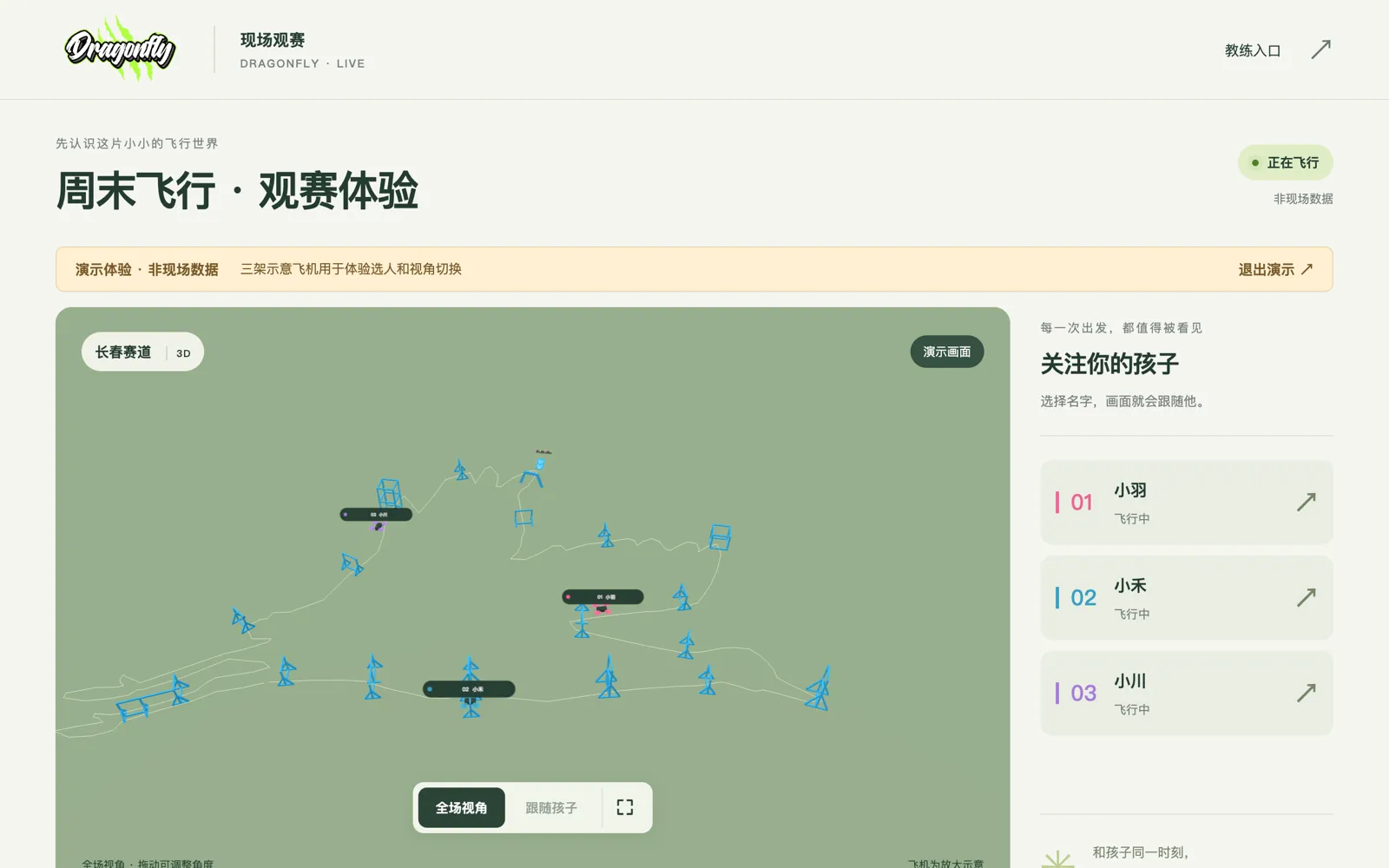
Beside autonomy sits a quieter conviction about light and sight. Moving faster inside the dark is easy to admire and hard to trust; spinning carbon blades leave no margin for hidden intent, so invisible trajectories need to be brought back into plain view. Within seconds of takeoff, parents, coaches, and marshals at the fence lose a goggle-flown quad against the trees, so I built TrackLine to turn live stick inputs and telemetry into a legible 3D flight path inside any browser. To keep fast airframes readable at dusk and through lenses, I wrote open-source C firmware on a 27-cent, 8-pin STC8G1K08A microcontroller bit-banging WS2812 signals at 35 MHz, co-designed 0.12-gram programmable LED strips with HGLRC, and partnered with DeepSpaceFPV on high-visibility PHLUX LED strips. Because solo practice had no impartial starter, I built RaceStarter for iPhone and Apple Watch across four international rule sets, ten languages, and local synced starts; because raw finishing order hides strength of field, I am rebuilding head-to-head pilot ratings inside FPV Super App.[11] Every tool began with one honest gap beside a field, went out rough, and became clearer through real use.
Exhibit III · Legible Flight & Gaze Benchmarks
Act VI
The Shared Sky Ahead
I used to want first place in everything, until I could no longer tell what I genuinely loved. When I founded and began coaching the SP Youth Team, I set that demand down. If a heat unravels, we check the tune, redraw the line, and walk back out for the next pack. What I hope these teenagers keep is steadier than any trophy: the patience to stay with a craft they care about and build a full life around it.
In spring 2025, I joined the national F9U training camp as an instructor. That October at China's 15th National Games in Shenzhen Longhua, while I flew for Hunan, thirteen-year-old Bai Xize won China's first National Games F9U gold medal, Cheng Guo took adult open bronze, and Wang Siqing, Wen Xirui, and Wu Qiuyan finished fourth in the team event, with Wen Xirui telling his school afterward that every single command and exchange mattered. Across 2025 and 2026, our Going Global plan turned into boarding passes: Wang Siqing won junior gold and placed fifth overall in the Open Top 64 in Muncie, Indiana, repeated as Serbia World Cup champion, and won the October 2026 Seoul World Cup alongside Bai Xize in third; Wu Qiuyan joined China's national reserve roster at eleven and won the women's title at the Ningbo World Cup; trips carried the team to Mongolia's DRONECON and unfamiliar winds beyond.[12]
Two weekends in 2026 will stay with me for a long time. In July in Serbia, I lined up on the exact same World Cup start grid as my students and finished eleventh while Wang Siqing took first, Peng Siyang took third, and Cheng Guo qualified fastest in the field. Two months later in Istanbul, among fifty-eight pilots from ten countries, I fought my way to seventh overall, then lifted my goggles to see Bai Xize, Cheng Guo, and Peng Siyang standing first, second, and third ahead of me.[13]
Watching fourteen-year-olds lift their goggles in foreign wind, checking each other's frames and packs, I understand why I can never pull the race course apart from the equations and code on my desk at USC. By the time these teenagers grow into their own work, the sky overhead will be shared by human pilots and autonomous machines alike.
Our part of that work stays quiet and concrete: account for every gram and watt, bring unseen trajectories back into the light, carry onboard autonomy safely out of enclosed rooms into real wind, and leave a few clear, quiet markers along the runway. That way, when the next generation pushes the throttle toward wider horizons, the sky they inherit will not be dark.