Autonomous Perception
In researchAIDrone
Training racing multirotors to fly agile courses using only onboard cameras and sensors, moving autonomous flight out of motion-capture labs into ordinary environments.
Nine years of racing drones at the physical limit, paired with physics and computer science at USC, showed me how fragile machines still are outside controlled rooms. My work focuses on turning human flight intuition into onboard autonomous perception, legible flight tools, and open engineering that serves people in ordinary air.

Three Commitments
Real air outvotes any spreadsheet. Whether weighing every gram and watt across 2:25:02 in Fuzhou or climbing from 28th in Riyadh qualifying (0:19.906/lap) to 6th overall, flight only trusts what holds up outside.
2:25:02 Fuzhou · Riyadh 28th → 6th
Spinning carbon blades leave no margin for hidden intent. TrackLine brings live 3D paths into any browser, 0.12g HGLRC LEDs and $0.27 open-source firmware clarify attitude in the dark, and AIDrone probes vision-only flight outside lab rooms.
TrackLine · 0.12g LED · AIDrone
Growing up beside Super Pulse's field-side soldering tables taught me a craft outlives any single peak. Through the SP Youth Team, teenage pilots now line up beside me at FAI World Cups from Serbia and Istanbul to Seoul.
Super Pulse → SP Youth Team
Core inquiry · Research
Researchers at the University of Zurich had 21 pilots race in a simulator while wearing eye trackers, finding that about 1.5 seconds and 16 meters before a gate, a pilot's gaze is already locked onto the inside of the turn. In 2023 the same lab's Swift system beat champion human pilots inside an indoor hangar, and in 2024 they flew a quadrotor from onboard camera pixels alone, with no inertial sensor, at up to 40 km/h.
This is the question I am trying to answer, and I have not answered it. AIDrone, the project I am working on, starts here: a quad that flies a racing track outside motion-capture rooms using only its onboard camera and sensors. It is still research.
From the fence, a flight looks like speed and clean arcs. Inside the goggles, the noise drops away until only an unseen seam remains beside the gate: an inch too wide bleeds time, an inch too close shatters carbon, and the whole craft lives in that single inch of restraint.
Research & Engineering
Every aircraft answers to three quiet constraints: gravity, stored energy, and sight. My engineering work follows those same bounds, focusing on onboard perception outside motion-capture rooms, strict mass and power budgets, and field tools that keep machine motion legible from the ground.
Autonomous Perception
In researchTraining racing multirotors to fly agile courses using only onboard cameras and sensors, moving autonomous flight out of motion-capture labs into ordinary environments.
Endurance & Flight Physics
2:25:02 verified flightAccounting for every gram and watt at the opposite extreme from two-minute sprint races. Our first public endurance battery architecture kept a multirotor aloft for 2 hours, 25 minutes and 2 seconds in Fuzhou.
Human Visibility · Live System
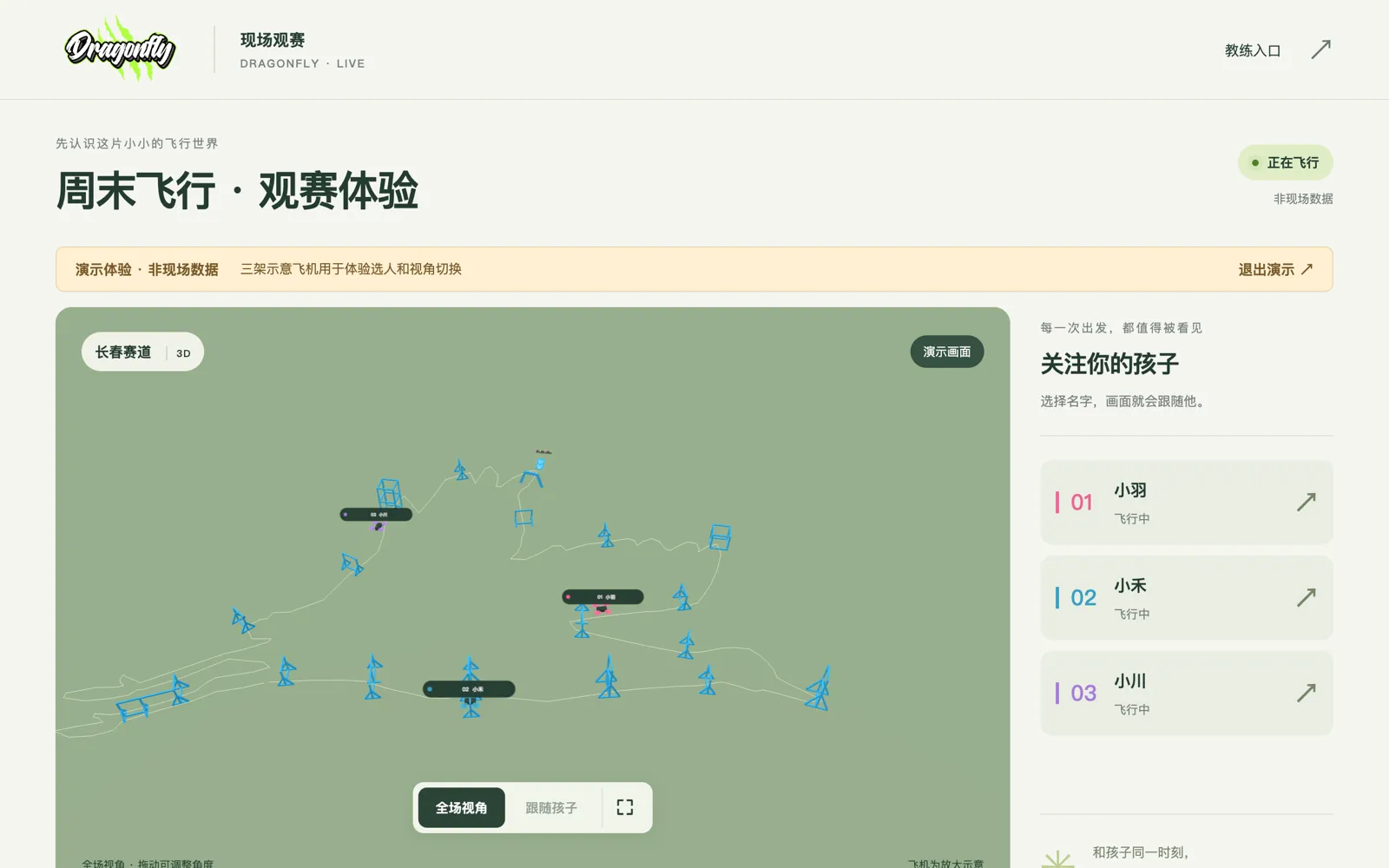
When pilots fly inside goggles, parents, coaches, and race marshals on the ground lose sight of intent and position within seconds. TrackLine reads telemetry and stick inputs and reconstructs the 3D flight path live in a browser.
Flight Tools & Hardware
Solo practice lacks an impartial start marshal, so I shipped an iPhone and Apple Watch start timer covering Standard, MultiGP, DRA, and FAI rules, ten languages, and LAN synced starts.
Co-designed 0.12g HGLRC LED LongXL and DeepSpaceFPV PHLUX LED strips, plus open-source C firmware on a $0.27 STC8G1K08A MCU so fast quads read clearly at night and on camera.
Finishing order alone ignores strength of field. Rebuilding pilot ratings that score head-to-head competition and race forecasts.
The Proving Ground · Drone Racing
Every instinct I bring to flight safety and engineering was tested first at 150 km/h on a race course: racing for the China National Drone Racing Team, placing 6th at the Riyadh World Cup from 28th in qualifying and 15th at the Hangzhou Worlds, selected to the Team China roster ahead of The World Games 2025 in Chengdu, and captaining the DCL China Dragons. Through the SP Youth Team, I now line up on international start lines from Serbia and Istanbul to Seoul beside the teenage pilots I coach.
Personal & Team China
National team results & verified records
SP Youth Team
Teenage pilots trained from the ground up
Going Global
World route map & overseas race trips
Whether you are working on autonomous flight, building tools for pilots, inviting a team to a race, or reaching out on behalf of media or partners, feel free to write anytime.
[email protected]